

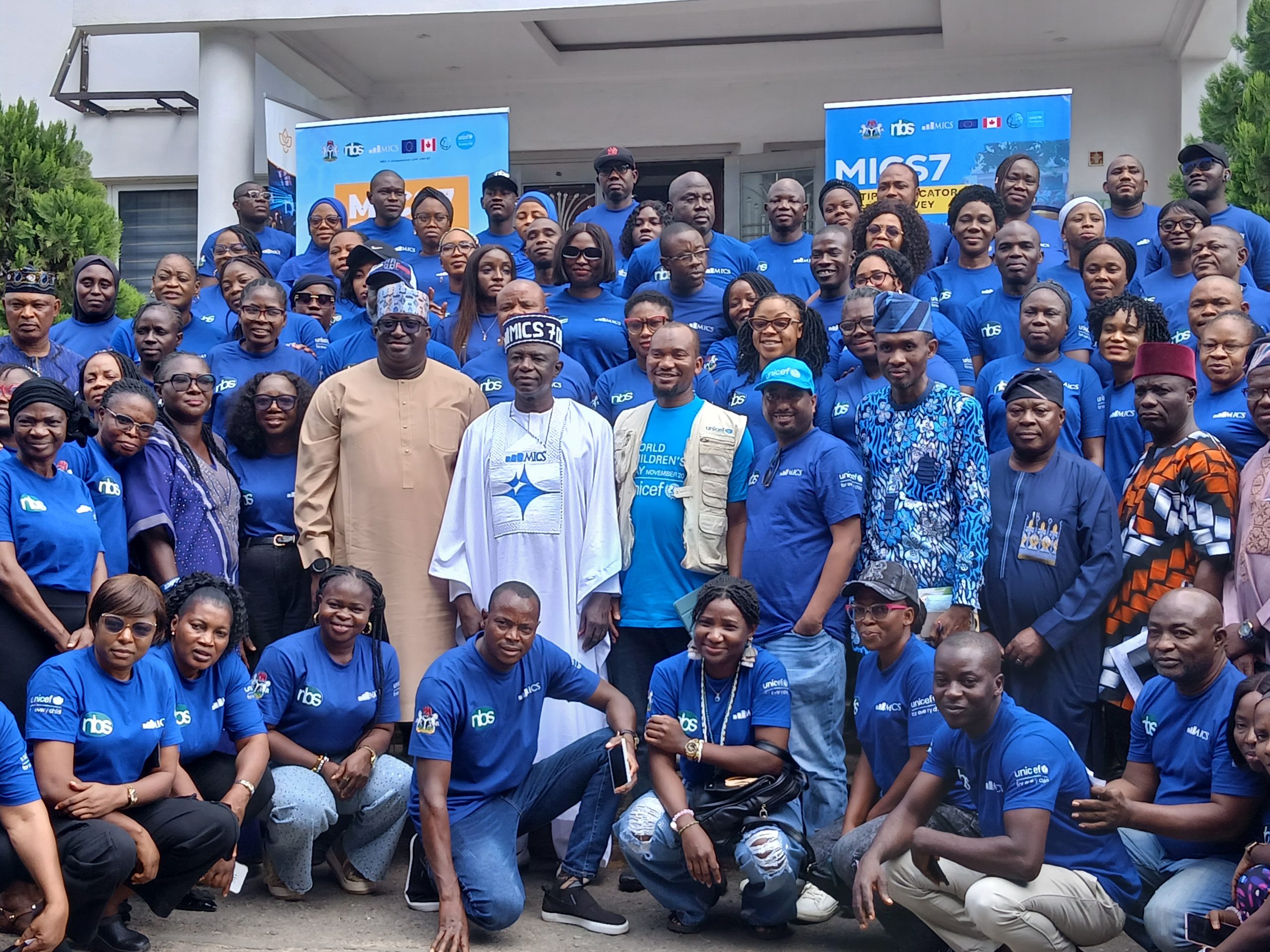
Reinforcing its commitment to data-driven governance, National Bureau of Statistics (NBS) launched the Seventh Round of the Multiple Indicator Cluster Survey (MICS7) in Ibadan, Oyo State, through a partnership between the Federal Government, United Nations Children’s Fund (UNICEF) and other development stakeholders.
The national flag-off, held at Kakanfo Inn and Conference Centre, underscored the growing collaboration between the National Bureau of Statistics (NBS), development partners and state-level institutions in strengthening the country’s statistical system. The survey is regarded globally as the most reliable source of high-quality data on the well-being of children, women and households.
Speaking on behalf of the Statistician-General of the Federation, Prince Adeyemi Adeniran, the NBS Director of Procurement, Mr. Audu Olokpo, said the launch of MICS7 reflects a sustained and productive partnership built over nearly three decades.
He noted that UNICEF’s technical and financial support has been instrumental in enhancing the credibility, quality and global alignment of Nigeria’s household data.
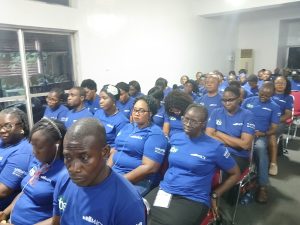 Olokpo described MICS7 as a pivotal tool for tracking human development progress and assessing how well Nigeria is meeting its commitments to children and families.
He emphasized that the survey will generate almost half of all Sustainable Development Goal (SDG) indicators measurable through household surveys, making it indispensable for national planning and policy evaluation.
He highlighted key innovations in this year’s round, including new modules covering early HPV, discrimination, post-emergency conditions, complementary feeding, reproductive health decision-making, and time-use, as well as the return of the anthropometric component. Digital enumeration maps, geo-mapping and strengthened quality-control systems will also be deployed, ensuring accuracy and full national coverage.
In his remarks, UNICEF Lagos Field Office’s Social Policy and Programme Manager, Muhammad Okori, said MICS remains the gold standard for measuring progress on children’s rights and welfare.
He stressed that UNICEF’s collaboration with NBS and government partners is essential for generating data that drives better policies in education, nutrition, immunization and child protection.
“This survey tells us where we are succeeding and where we must do more. It is a crucial tool for ensuring that Nigerian children do not get left behind,” Okori stated.
Also speaking, the National Consultant for MICS7, Dr. Isiaka Olarewaju, pointed to new additions such as measuring learning foundations for school-aged children and expanded time-use indicators.
He noted that digital data capture would allow secure, real-time transmission, enhancing transparency and efficiency.
Stakeholders at the event praised the synergy among federal ministries, state statistical offices, development partners and technical experts, noting that such cooperation has strengthened confidence in Nigeria’s data ecosystem.
They urged selected households and community leaders nationwide to support field officers as data collection begins on December 3.
With more than two months of fieldwork scheduled across the country, officials expressed optimism that the results of MICS7 will guide smarter investments and more effective policies for children, women and families.

