

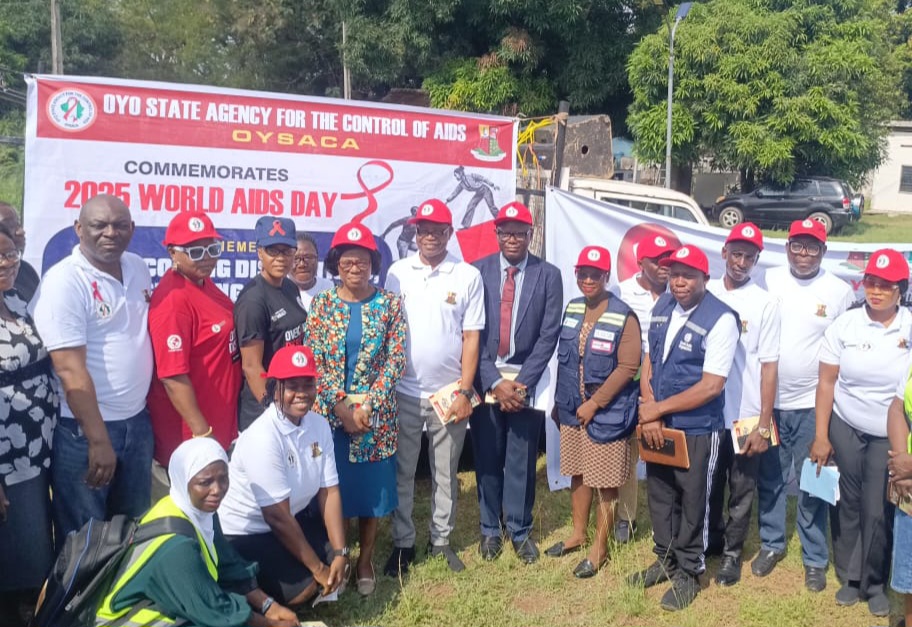
The Oyo State Government has reaffirmed its commitment to sustaining the fight against HIV/AIDS, despite the steady decline in global funding support.
This was revealed by the State’s Commissioner for Health, Dr. Oluwaserimi Ajetunmobi at the flag off commemoration of 2025 World AIDs Day (2025 WAD), organized by the State Agency for the Control of AIDs (OYSACA).
Ajetunmobi explained the impact of dwindling global funding on HIV/AIDS efforts across the nation and warned that the state’s hard-won progress, with an HIV prevalence of 0.9%, risks reversal without urgent action.
She said that “We want to make sure that there is no gap at all in the State due founding gap of the US Policy shift so that the gain we have in past will not go down again because HIV prevalence in the State is about 0.9 Percent and we don’t want it to go up again.”
The Commissioner emphasized that this year’s World AIDS Day theme, “Overcoming Disruption: Sustaining Nigeria’s HIV Response,” calls for a three-pillar approach involving the Government, Healthcare Workers, and the Community.
She highlighted that Governor Seyi Makinde’s administration has prioritized health, allocating funds in the 2025–2026 budget for integrated AIDS, Tuberculosis and Malaria cares ( ATM), ensuring affordable, accessible testing, counseling, and treatment at revitalized our Primary Healthcare Centers.
While acknowledging the ongoing ‘japa’ trend among health workers, Dr. Ajetunmobi assured that the government will address the shortage of personnel by promptly recruiting more healthcare officers.
At the Community level, she called for stronger collaboration with traditional and religious leaders to reduce stigma, improve access to care and encourage community ownership of health programmes
She said that “As we all know that we are having dwindling partner support and that is why we are taking ownership of everybody’s health in the State.
“His Excellency, Engr. Seyi Makinde, has consistently prioritized health as a key pillar of his administration. This commitment is evident in the allocation of funds in our annual operational plan and the 2026 Budget for integrated healthcare services.
The focus is not only on people living with HIV but also on those affected by Tuberculosis and Malaria—collectively referred to as ATM (AIDS, Tuberculosis, and Malaria). The goal is to provide comprehensive, affordable, and accessible care for all residents of the State.”
“Our Primary Healthcare Centers have been revitalized and have been equipped to be able to have where we can test and offer counselling and treatment for our people that are tested positive.”
“Our efforts are on ground to ensure that healthcare in the State goes beyond what is immediately visible. We address both communicable and non-communicable diseases, while also providing counseling and psychological support to every resident of the State.”
“We have recruited more health workers in the past year to strengthen our workforce, and despite the japa syndrome, we continue to train those available so they are equipped and compassionate in delivering quality care.”
“We are working closely with community, traditional, and religious leaders, as they can communicate directly with the people in ways they understand and guide them to access care at nearby Primary Healthcare Centers.
“Everyone needs to take ownership of their health. The government is doing its part, the community is doing theirs, but individuals must also take responsibility for their own well-being,” Ajetunmobi concluded.
Speaking also at the event, The Chairman, Oyo State Agency for the Control of AIDs (OYSACA), Aare Dr. Gbola Adetunji disclosed that the Agency has strengthened its prevention programmes, focusing on education, counseling, condom distribution and mother to child transmission prevention.
Adetunji discussed the need for a new transformative approach to end AIDs by 2030 as targeted in 95-95-95 by UNAIDS (Aim for 95% of people living with HIV to know their status, 95% of those diagnosed to be on sustained treatment, and 95% of those on treatment to achieve viral suppression, designed to transform HIV care and control the epidemic).
He said that “there is a need to chart new trends in combatting HIV with the hope of ending it by 2030 as specified by the United Nations Programme on HIV/AIDS (UNAIDS).
Highlights of the event include rally/roadshow, counselling, free Malaria; Tuberculosis; and HIV testing.
The World AIDS Day is globally celebrated on December 1st to raise awareness of HIV/AIDS, show support for people living with HIV, and commemorate those who have died from the disease.

