

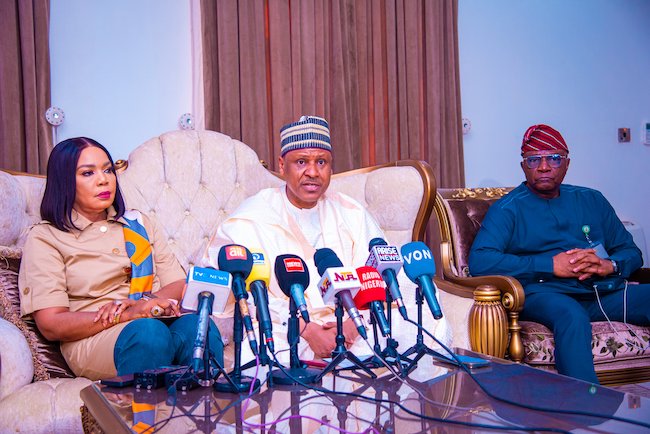
The Federal Government of Nigeria has called on labour unions to resume negotiations regarding the new minimum wage.
This appeal, made by Minister of Information and National Orientation, Mohammed Idris, at a press conference in Abuja on Monday, underscores the government’s commitment to achieving a peaceful and mutually beneficial outcome.
Idris highlighted the recent collaborative efforts between the National Assembly and the government to engage with the labour unions. He reiterated the Federal Government’s openness to dialogue, emphasizing the importance of a collaborative approach.
“We will continue to engage and make ourselves very available in these negotiations on behalf of the Nigerian people,”
Idris stated. “We are not opponents at the negotiating table. We are united by the goal of achieving the best for the Federal Republic of Nigeria and all 200 million citizens.”
He stressed the need for a balanced and realistic resolution, noting the significant implications of the labour unions’ current proposal.
According to Idris, this proposed increase would result in an annual wage bill of N9.5 trillion for the Federal Government alone, not accounting for additional costs to state governments and private sector employers. Such an increase, Idris warned, could severely impact the economy and lead to massive job losses.
The government has pointed to other measures aimed at alleviating economic pressures on Nigerians, such as the National Consumer Credit Scheme and the Nigerian Education Loan Fund. Idris emphasized that relief for Nigerians should not only come through increased wages but also through efforts to reduce the cost of living and ensure more disposable income.
The Nigeria Labour Congress (NLC) declared a nationwide indefinite strike starting at midnight on Sunday, June 2, 2024, due to the Federal Government’s refusal to increase the proposed minimum wage above N60,000. The President of the NLC, Joe Ajaero, announced the strike following failed negotiations between the government and organised labour.
Despite the government’s final offer of N60,000, which included a recent increase from an initial N57,000, the labour unions found the proposal insufficient.
During the latest meeting, labour unions revised their demand, reducing it by N3,000 from the initial N497,000 proposed the previous week, setting the new proposal at N494,000. Despite this concession, the negotiations remained deadlocked as the government maintained its offer of N60,000, leading to the declaration of a nationwide indefinite strike.
On Monday, several unions shut their workplaces in compliance with the directive of the two major labour unions to embark on an indefinite nationwide strike.
He emphasizing the government’s commitment to finding a sustainable solution that balances the needs of workers with the broader economic stability of the nation.
He urged all parties to return to the negotiating table with a spirit of cooperation and compromise, ensuring that the final agreement benefits all Nigerians, Idris concluded.

