

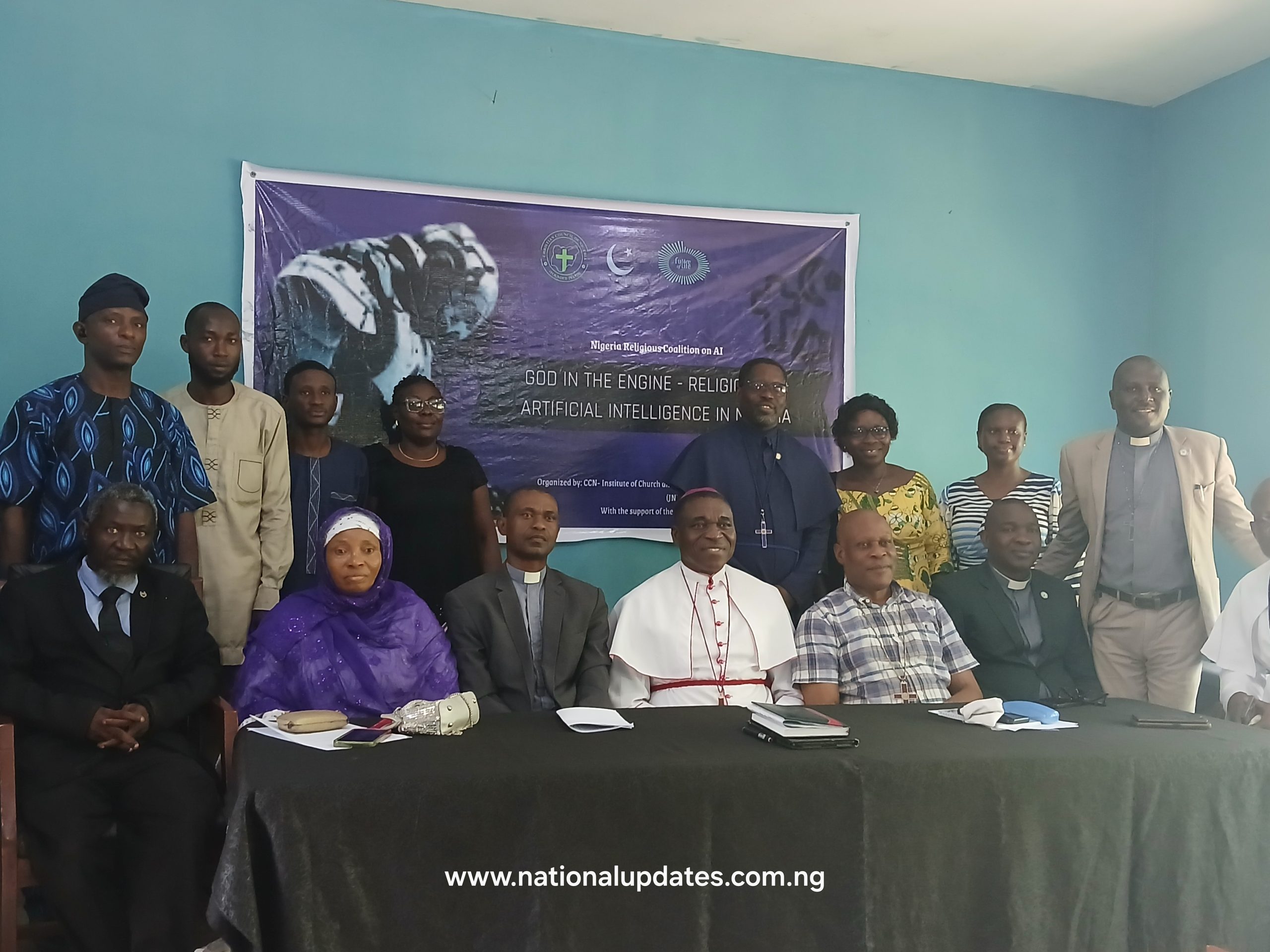
A coalition of religious leaders in Nigeria has called on the government to establish a comprehensive legal framework to regulate the use of Artificial Intelligence (AI), citing ethical concerns, job displacement, and potential moral implications.
Speaking at the press briefing organised by Nigeria Religious Coalition in collaboration with Future of Life Institute held at Institute of Church and Society, Samonda, Ibadan, Bishop of Methodist Church Agodi Diocese Nigeria, Rev. Oluwole Onaleke stated that Nigerians should push for the establishment of International governance framework to safeguard against the global risks of world-leading Artificial Intelligence developments.
According to him, “it is a fact that Artificial Intelligence has power to make the world move faster and proffer solutions to specific issues in today’s society.
We will be lying to ourselves if we think that technological development does not have an effect on humanity or has a tendency to make men think and act like they are God, even when such acts affect their fellow humans.”
Rev. Onaleke stressed that artificial intelligence companies aim to change what it means to be human and create their own false god.
Meanwhile, artificial intelligence’s impact on democracy, jobs and human relationships will be profoundly disruptive for society and without religious leadership guiding the community through these changes, we risk widespread and unprecedented chaos,” he said.
Rev. Onaleke added that Nigerians are in a strong position to harness the numerous offered controllable Artificial Intelligence tools in agriculture, education, healthcare, religion and many more.
“Artificial Intelligence should be built and used safely and ethically in line with Nigeria’s religious values, traditions and communities that people are protected from AI manipulation and that workers’ rights and livelihood should be respected and prioritised.”
The Chairman, Institute of Church and Society, Ven. Femi Taiwo pointed out that “religious communities need to have conversations on the need to create a balance between the technological world and the religious world so that what is meant to give relief will not create more deadly problems for humanity.”
He added that “one of the worst possible outcomes for Artificial Intelligence is that of polarizing two worlds: the technological world and the religious world.”
Ven. Taiwo enjoined religious groups to be proactive in learning with caution and the application of Artificial Intelligence in daily endeavours to prevent misleading teachings on congregations and the general public against religious doctrines.
While highlighting the efforts of the religious bodies on teaching ethical concerns, the representative of the Federation of Muslim Women Association of Nigeria (FOMWAN), Alhaja Airat Ogungbenro mentioned that several educational, youth and national conferences are being organised regularly for members and general public on right religious teachings, including Artificial Intelligence usage.
She further submitted that attention should be placed on Artificial Intelligence from becoming “an idol or leading religious believers astray through manipulation” which is possible in its usage.
In his own submissions, Bishop of Methodist Church Elekuro Diocese Nigeria Rev. David Adekoya advised religious believers to be well grounded in their beliefs to guard against wrong information consumption, which is sometimes generated in the use of Artificial Intelligence.
He also expressed concern over the overdependence on Artificial Intelligence by children and students in relation to child development which he believed is capable of eroding human intellectual efforts in academics and research.
In his closing remarks, Rev. Kolade Fadahunsi emphasised that the extinction of mankind due to Artificial Intelligence should be discouraged at all costs, noting that religious bodies should be involved in policies that guide AI use and consumption in Nigeria.

